

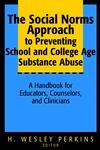
Information about the publication of The Social Norms Approach to Preventing School and College Age Substance Abuse: A Handbook for Educators, Counselors, and Clinicians, edited by H. Wesley Perkins, Ph.D., is now available on the Jossey-Bass web site:
http://www.josseybass.com/cda/product/0,,078796459X|desc|2548,00.htmlThe contents of this page include a description of this 336-page volume, the table of contents (see below), an extended excerpt from the book available in PDF format, and ordering information.
The book was published in February 2003.
The Social Norms Approach to Preventing School and College Age Substance Abuse offers educators, counselors, and clinicians a handbook for understanding and implementing a new and highly successful alternative to traditional methods for preventing substance abuse among young people. The proven "social norms" approach outlined in this book identifies young people's dramatic misperceptions about their peer norms and promotes accurate public reporting of actual positive norms that exist in all student populations. The contributors to this important book are the originators, pioneers, and active proponents of this new approach. Many of them have successfully applied the social norms approach in secondary and higher education settings and as a result have promoted healthier lifestyles among adolescents and young adults across the United States.
Here are some advance readers' comments:
"Too much talk about the alcohol issue is rhetorical. The Social Norms Approach offers a refreshingly honest and helpful approach to the drinking crisis on our campuses by using the peer group as part of the solution."
—Richard H. Hersh, president, Trinity College, Hartford, Connecticut
"This book is a compendium of applications and cutting-edge findings for a promising new approach to campus alcohol abuse prevention. It is essential reading for student personnel administrators in college mental health, fraternity and sorority affairs, and alcohol and other drug abuse counseling."
—Phillip W. Meilman, director, Counseling and Psychological Services, Courtesy Professor of Human Development, Associate Professor of Psychology in Clinical Psychiatry, Cornell University
"At last, a compendium of social norms information that addresses both the theory and practice of employing this model in higher and secondary education. This social norms handbook for educators, counselors, and clinicians succinctly prepares these professionals to 'act on' high-risk student behavior rather than 'react to' it."
—Robert J. Chapman, coordinator, AOD Program Associate Faculty, Clinical and Counseling Psychology, La Salle University
"Social norms pioneer Wes Perkins has assembled the country's leading theorists and practitioners to create the most comprehensive guide available in this cutting-edge field."
—Timothy C. Marchell, Director of Alcohol Policy Initiatives, Cornell University
"High-risk drinking and its consequences continue to plague those of us in higher education administration. If five years from now we are still chasing our tails ineffectually because we haven't put the empirically based strategies outlined in this book into practice on our campuses—then shame on us."
—Ray Schwarz, Associate Vice President for Student Affairs, State University of New York, College at New Paltz
"In my community, multiple efforts to reduce underage drinking accomplished little more than dividing it between those who believe in an abstinence only approach, and those who believe in a risk reduction approach. When I began to introduce the social norm theory, I found a new sense of hope that there may finally be something that we could do, as a community, to make progress on this important issue. From the students themselves, to the parents and teachers, our community is uniting behind the positive, non-moralistic and non-coercive approach found in this book."
—Lisa Stone, MD, vice-chairman, Board of Health, member, Drug and Alcohol Prevention Advisory Coalition, Wellesley, Massachusetts, and parent of three teenagers
THE SOCIAL NORMS APPROACH TO PREVENTING SCHOOL AND COLLEGE AGE SUBSTANCE ABUSE: A HANDBOOK FOR EDUCATORS, COUNSELORS, CLINICIANS
(Publication date: February 2003)
Editor
H. Wesley Perkins, PhD
Professor of Sociology
Department of Anthropology and Sociology
Hobart and William Smith Colleges
Geneva, NY 14456
Web Sites: people.hws.edu/perkins & alcohol.hws.edu
Publisher
Jossey-Bass
989 Market Street, San Francisco, CA
A Publishing Unit of John Wiley & Sons, Inc.
Contents
PART I: Introduction1. The Emergence and Evolution of the Social Norms Approach
by H. Wesley Perkins
This chapter introduces the Social Norms Approach with an historical description of the evolution of prevention strategies to the emergence of this approach and how the discovery of misperceived peer norms led to the proposal of this prevention strategy.
PART II: Case Studies of Campus Experiments to Reduce Alcohol Abuse2. The NIU Experiment: A Case Study of the Social Norms Approach
by Michael P. Haines
This chapter presents the first applied experiment using the approach in a college student population. The experiment used print media and co-curricular activities publicizing actual norms to change perceptions and, in turn, documented a dramatic and continuing decline in heavy drinking among students.
3. The University of Arizona's Campus Health Social Norms Media Campaign
by Koreen Johannessen
This chapter reports on a replication of the NIU print media strategy to reduce misperceptions that refined and further developed the production of media images and applied the strategy in a large southwestern university context. Again, a significant reduction in heavy drinking was the result.
4. The HWS Experiment: A Synergistic Social Norms Approach Using Print, Electronic Media and Curriculum Infusion to Reduce Collegiate Problem Drinking
by H. Wesley Perkins and David Craig
This chapter describes the development and results of an experimental social norms intervention implementing multiple interlinked strategies to achieve a synergistic effect in reducing misperceived drinking norms. Electronic media and curricular innovations were designed to enhance and extend print media communicating actual student norms and producing dramatic reductions in high risk drinking and negative consequences. Results from multiple evaluations demonstrate both immediate and long term positive effects.
5. Applying the Social Norms Model to Universal and Indicated Alcohol Interventions at
Western Washington University
by Patricia Fabiano
In yet another region of the country a print media campaign was conducted, this time adding social norms delivery through a large peer educator program and, for students already manifesting alcohol problems, delivery through an alcohol screening and intervention program. This chapter describes how a significant reduction in high risk drinking was also achieved in this university context where commuting and non-traditional students were a significant portion of the student body.
6. The Rowan University Social Norms Project
by Linda Jeffrey, Pam Negro, DeMond Miller, and John D. Frisone
This chapter reports a replication of the social norms intervention approach with print media at an East Coast university. Assessment results demonstrate that as exposure to campaign materials increased each year a corresponding reduction in high risk drinking was the result.
7. The Small Group Model: Social Norms Intervention with Targeted High Risk Groups
by Jeanne Far John Miller
This chapter reports the strategies and results of multiple efforts to reduce misperceived peer norms and related high-risk drinking through workshop formats and small group interaction in a variety of social group contexts. Targeted high risk groups included fraternity, sorority, and athletic team members.
PART III: Expanding Social Norms Interventions to Other Campus Applications
8. Perceptions, Norms and Tobacco Use in College Residence Hall Freshmen: Evaluation of a Social Norms Marketing Intervention
by Linda Hancock and Neil Henry
The social norms approach can be applied to substance abuse prevention other than problem drinking. This chapter describes an experiment to reduce the onset of smoking among new college students using a social norms marketing strategy at one university and compares the outcome with data from another school acting as a control site. The experiment demonstrated a significant reduction in onset of smoking among students exposed messages about accurate student norms.
9. A Social Norms Approach to Building Campus Support for Policy Change
by William DeJong
This chapter argues that the social norms approach can provide an important first step in the application of other environmental strategies such as strengthening public policies. Policy controls are likely to be more effective if there is known to be significant student support and yet students often underestimate the level of support for regulations that actually exists among peers. Survey data are presented to support this claim and the implications are discussed for building comprehensive prevention strategies.
PART IV: Young Adults and Social Norms Work beyond the Campus
10. Misperceptions of Peer Alcohol Norms in a Statewide Survey of Young Adults
by Jeff Linkenbach and H. Wesley Perkins
Research has begun to explore the phenomenon of misperceived peer norms among adolescents and young adults and it pervasiveness in contexts beyond the college setting. This chapter reports the results of a state-wide survey of 18 to 24 year old residents in Montana that examines actual and perceived norms for frequency and quantity of alcohol consumption and prevalence of drinking and driving. Results again reveal dramatic discrepancies between actual and perceived norms for both men and women.
11. Statewide Applications of Social Norms Marketing: The Montana Modelby Jeff Linkenbach
This chapter discusses the strategic steps taken by one social norms program to take this strategy for promoting health to a statewide level of implementation and reviews issues ranging from data gathering to message development to building coalitions and stakeholder support for this approach.
PART V: The Social Norms Approach in Middle and High School Populations
12. Substance Use Norms and the Developmental Pattern of Misperceptions in Secondary Education
by H. Wesley Perkins and David Craig
This chapter reveals the pervasive pattern of misperceptions regarding peer tobacco, alcohol and marijuana norms found among middle and high school students across the nation. The data were collected in a web-based survey conducted in twenty-two schools in five states spread throughout the U.S. The chapter reveals the dramatic potential for introducing the social norms model in secondary education based on these findings and it also demonstrates the growth of misperceived norms as students move through grade levels.
13. Most of Us Are Tobacco Free: An Eight-Month Social Norms Campaign Reducing Youth Initiation of Smoking in Montana
by Jeff Linkenbach and H. wesley Perkins
This chapter describes a social norms experiment conducted among 12 to 17 year olds living in seven Montana counties with results compared to youth in the rest of the state. The social norms media intervention was associated with a dramatically lower rate of first-time use of tobacco by the end of the experimental time period when compared to first-time use rates in the rest of the state where other types of prevention strategies were employed.
14. Using Social Norms To Reduce Alcohol And Tobacco Use in Two Midwestern High Schools
by Michael P. Haines, Gregory Barker, and Richard Rice
This chapter describes the intervention conducted at two Midwestern high schools using social norms media to significantly reduce cigarette smoking and drinking among 10th grade students during a two-year period. This project was unique among social norms interventions in that it used media to change the perceptions of parents and teachers as well as the students themselves.
PART VI: Further Applications of the Social Norms Model to Promote Health and Well-Being
15. Parents' Perceptions of Parenting Norms: The Social Norms Approach in Intergenerational Context
by Jeff Linkenbach et al.
This chapter reports on a state-wide study of parents of teenage children that examines parenting behaviors and parents' perceptions of other parents. Parents typical misperceive the norms of other parents believing them to be less involved and more permissive in parenting as related to curfews, talking with teens about substance use, and other serious concerns than is actually the case. This study demonstrates a circumstance in which the social norms approach can be extended to family life. The chapter also presents examples of media intervention resulting from these findings.
16. Application of Social Norms Theory to Other Health and Social Justice Issues
by Alan Berkowitz
The phenomenon of misperceived norms goes well beyond alcohol and other drug use and can be observed in areas of prevention work including hate speech, sexual aggression among men, and eating disorders among women. This chapter extends the horizon for using a social norms approach to these areas and provides a review of the limited work of relevance. It concludes with speculation about the utility as well as limitations of a social norms approach for these other areas.
17. Conclusions: The Promise and Challenge of Future Work on the Social Norms Model
by H. Wesley Perkins
The concluding chapter summarizes the promise of the social norms approach based on the range of available research and points out what research is needed to address remaining questions. The chapter also addresses common questions and criticism about this method of promoting health.
The National Social Norms Resource Center
www.socialnorm.org